


A note before we begin.
This is the first issue of Field Notes, the publication you may have known until recently as Media Minds. The rename is not cosmetic. Over the last year, the work we do at Adriana Lacy Consulting has shifted in a direction that the old name could no longer carry, and we wanted the publication to reflect where the firm actually is rather than where it used to be.
We spend most of our time now on strategic research and advisory work for foundations, universities, advocacy organizations, newsrooms, and corporate communications teams that are trying to make sense of a moment in which almost every assumption about how institutions reach audiences has come under pressure. Artificial intelligence is rewriting the economics of attention, demographic categories that once predicted behavior have stopped doing so, and the institutions that have traditionally held authority are being asked to earn it on terms they did not set. The questions our clients bring us are no longer about tactics but about whether the strategic frameworks they have relied on for a generation still apply, and if not, what should replace them.
Field Notes is where we work out the answers in public. It is a publication about audience, trust, and the institutions navigating artificial intelligence and communications, written from inside a practice that is engaging these questions every day with organizations whose budgets, missions, and reputations depend on getting them right.
We wanted to begin with a piece that sits at the center of how our thinking has evolved.
What demographics miss
Most institutional communications teams can describe their audience in remarkable detail. They know the age distribution, the gender split, the geographic concentration, the income brackets, the education levels. They build strategy decks around these numbers and present them to boards and funders as evidence of strategic clarity. The problem is that demographic data answers a question institutions have stopped needing to ask. Knowing who your audience is, in the spreadsheet sense, tells you almost nothing about whether your work reaches them, whether they trust it, whether they will return to it, or whether they will support it.
The argument in our inaugural piece is that audiences are not best understood by who they are, but by the situations they are in, and that those situations have three components we have come to call task, context, and intent.
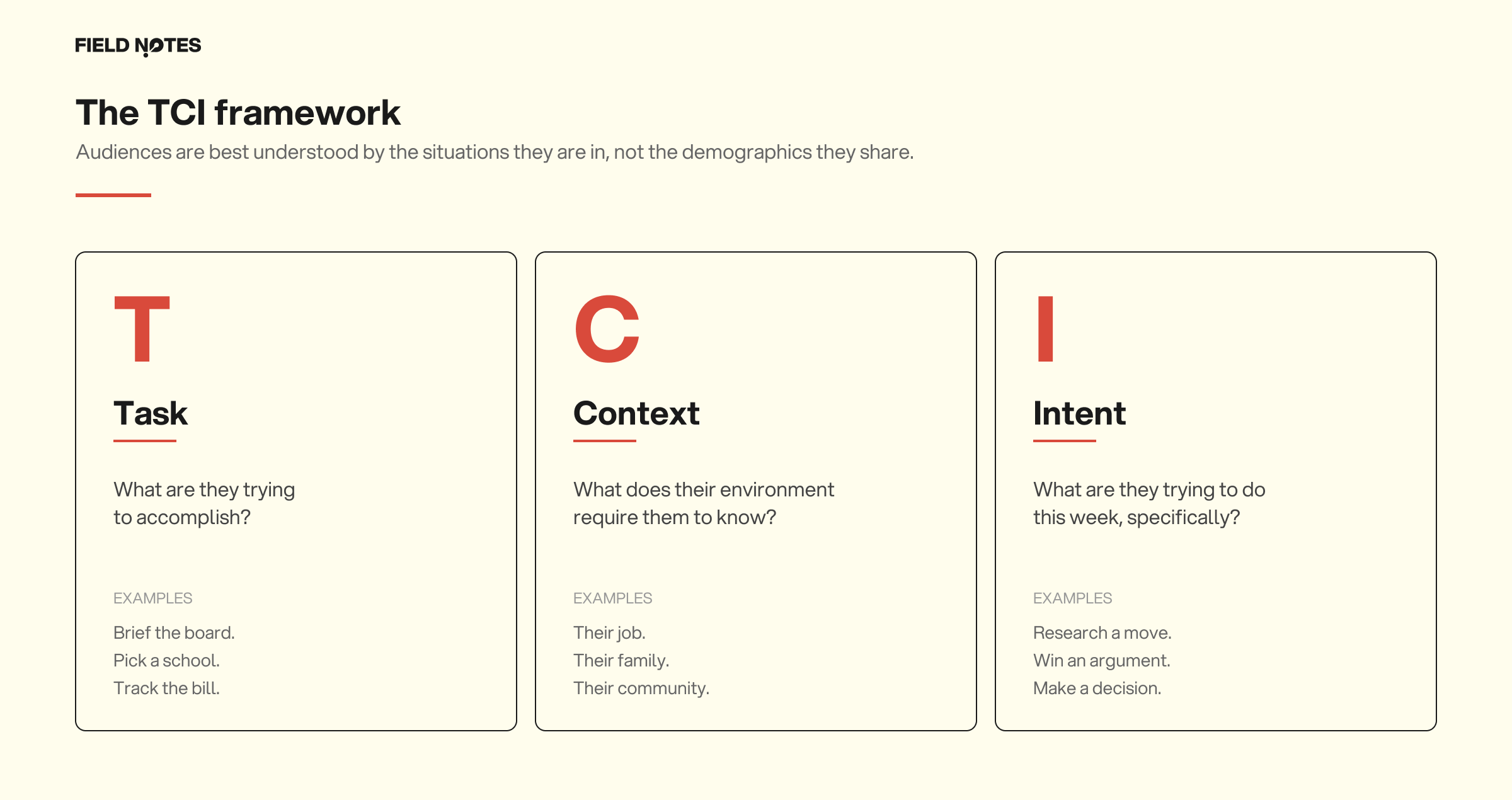
A task is what someone is actually trying to accomplish in their work or their life. A school board member following district budget debates and a parent trying to figure out which schools to apply to may be the same age, in the same town, with the same household income, and they are not the same audience because they are doing entirely different work. Context is what someone's surrounding environment requires them to know, which is the closest demographic thinking has historically come to getting it right and also where it most consistently fails. A nonprofit executive director running a twenty million dollar organization has to track state budget cycles whether she enjoys doing so or not; a retiree in the same zip code does not, and the first will read your statehouse coverage closely while the second will ignore it even if she tells every survey that she is engaged with local issues. Intent is what someone is trying to do this week, not in the abstract but actually this week. Someone considering a move to a new city is in a research mode that may last sixty days, after which she will never click on a neighborhood guide again. Someone whose teenager has been pulled into a school redistricting fight is in a research mode that lasts about three weeks. Demographics will tell you both are parents. Intent will tell you they need different things, in different windows, and that those windows close.
We call this task, context, intent, or TCI, and the practical value of the framework is that it produces different answers than demographic analysis would produce. It tells you which audiences are durable and which are episodic, which products are doing the work you think they are doing and which are filling time, when to invest in someone and when to let them pass through, and what to build next.
The framework did not arrive in a vacuum. The most influential prior work on this problem is the late Harvard Business School professor Clayton Christensen's jobs-to-be-done theory, which argued that customers do not buy products because of who they are but because they are trying to accomplish something specific, and the product is what they hire to do the job. A parallel insight emerged from the BBC World Service in 2016, when an internal audit revealed that seventy percent of the organization's content was update-style stories while those stories accounted for only seven percent of total page views, a finding that gave rise to the User Needs model now used across European public broadcasting.
Both frameworks correctly identified that demographics fail because they describe people rather than situations, and both have produced real results in the institutions that adopted them. Neither, however, was designed for the strategic problem institutional communications teams now face. Jobs-to-be-done was developed for product strategy in consumer markets. The User Needs model was developed for newsroom content portfolios. TCI is what happens when you take the underlying insight, that situations matter more than identities, and design specifically for the full strategic communications portfolio of an institution that includes research, events, advocacy, and stakeholder engagement alongside content.
How we use this in practice
TCI is not a thought experiment. It is the analytical spine of the strategic research engagements we run with foundations and institutions, the audience work we do inside newsrooms, and the advisory retainers we hold with leaders who are rebuilding their communications strategy from the situation up rather than the demographic down. When a client comes to us asking whether to launch a podcast, the framework gives us a more useful question to ask in return, which is what task is being done badly for the people they serve and whether a podcast is the right form for that task. When a client asks us to help them understand why their audience numbers are moving in the wrong direction, the framework helps us locate the answer in the situations their work no longer serves, rather than in the demographics it still describes.
The publication you are reading is one expression of this practice. The consulting work is the other.
If your institution is asking the questions Field Notes is built around, our strategic research, advisory retainers, and trends and foresight engagements are designed for exactly this moment. You can learn more about how we work with foundations, universities, newsrooms, and mission-driven organizations at adrianalacyconsulting.com.