

Most institutional communications teams can describe their audience in remarkable detail. They know the age distribution, the gender split, the geographic concentration, often the income brackets and education levels. They run quarterly reports on these numbers, build strategy decks around them, and present them to boards and funders as evidence of strategic clarity.
Demographic data answers a question that institutions have stopped needing to ask. Knowing who your audience is, in the spreadsheet sense, tells you almost nothing about whether your work reaches them, whether they trust it, whether they will return to it, or whether they will support it. Those are different questions, and they have answers that demographics cannot produce.
This applies to newsrooms, but it also applies to foundations communicating with grantee networks, universities trying to reach prospective students, advocacy organizations building supporter bases, and corporate communications teams engaging stakeholders. The mistake travels across sectors because the underlying assumption is the same: that who someone is predicts what they will pay attention to. That assumption used to be reasonable. It is not anymore.
What demographic segmentation actually measures
To see why, consider what age once told us and what it no longer tells us.
In 1985, knowing that someone was a 34-year-old woman with a college degree living in a mid-size American city was genuinely predictive. It told you, with reasonable accuracy, what newspapers she read, what television she watched, what her information environment looked like during the day, and what kinds of institutional messages she was likely to encounter. Demographic categories worked because the media environment was relatively shared and the institutional landscape was relatively stable. People who looked alike on paper consumed similar information, held similar reference points, and faced similar decisions on similar timelines.
That coherence is gone. The same 34-year-old today might be a policy director at a regional health system tracking state legislative activity for her job, or she might run a small contracting business and need to know when permitting rules change in her county. She might spend two hours a day in a Slack workspace for women in policy, or she might never use Slack and follow industry developments through three trade publications and a group text. Demographics cannot distinguish between these two people. They are the same on paper and entirely different in practice.
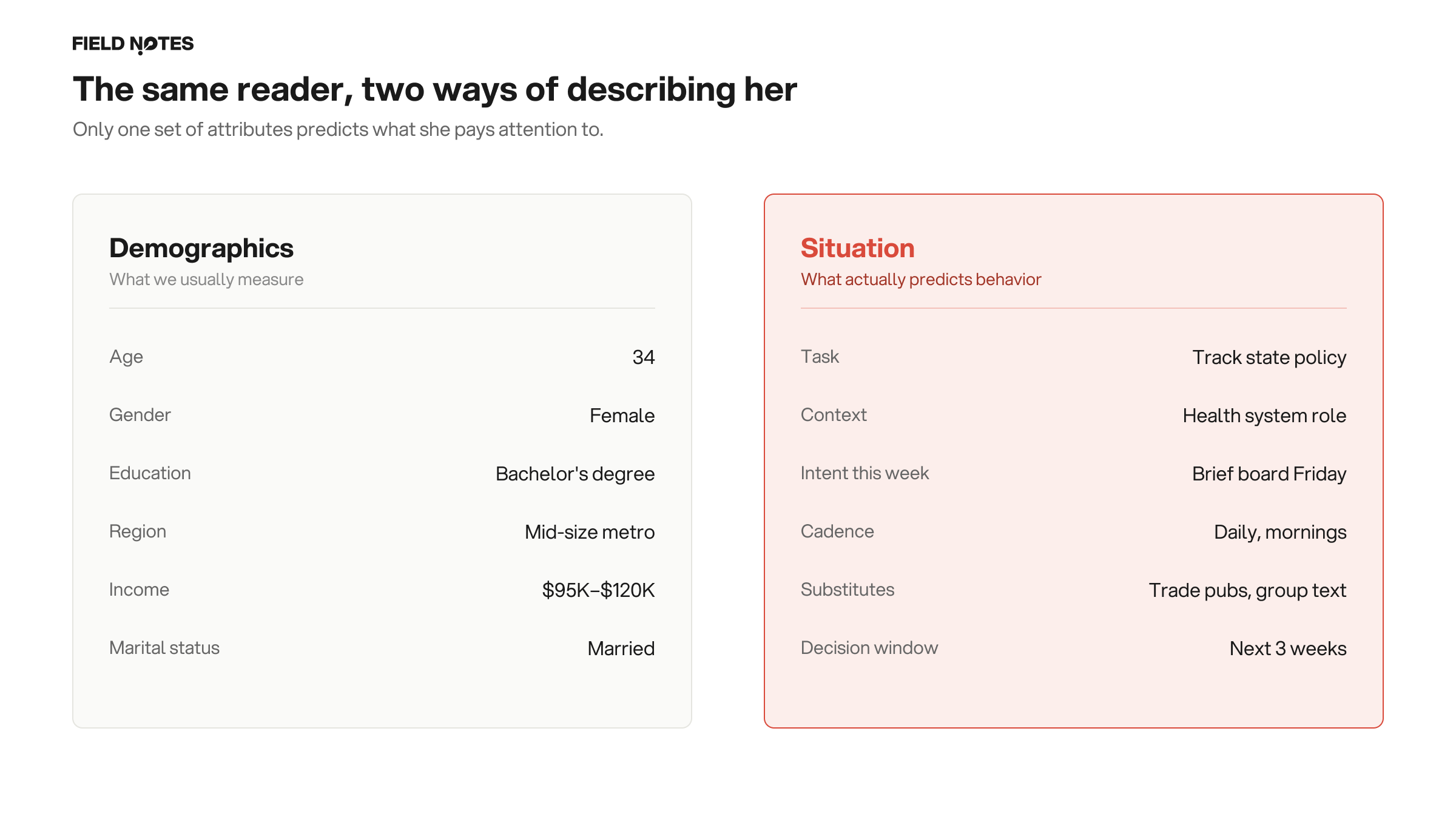
What changed is not the people. It is the information environment. The collapse of shared media, the proliferation of niche professional communities, the rise of platform-mediated identity, and the acceleration of work specialization have all made demographic categories less predictive of behavior than they were a generation ago.
The frameworks that almost work
A handful of useful frameworks have emerged in response to this problem, and any honest discussion of where institutional audience thinking is going has to acknowledge them.
The most influential is the late Harvard Business School professor Clayton Christensen's jobs-to-be-done theory, which argues that customers do not buy products because of who they are but because they are trying to accomplish something specific, and the product is what they "hire" to accomplish it. Christensen's milkshake case study is the canonical illustration: a fast food chain learned far more from understanding what job its milkshakes were doing for morning commuters than from any amount of demographic segmentation.
A parallel insight emerged from the BBC World Service in 2016, when an internal audit found that 70% of the organization's content was "update me" stories while those stories accounted for only 7% of total page views. Out of that audit came the User Needs model, which identifies a small number of distinct reasons people consume content (update me, give me perspective, educate me, inspire me, and others) and argues that institutions should design their content portfolios to serve those needs deliberately rather than incidentally.
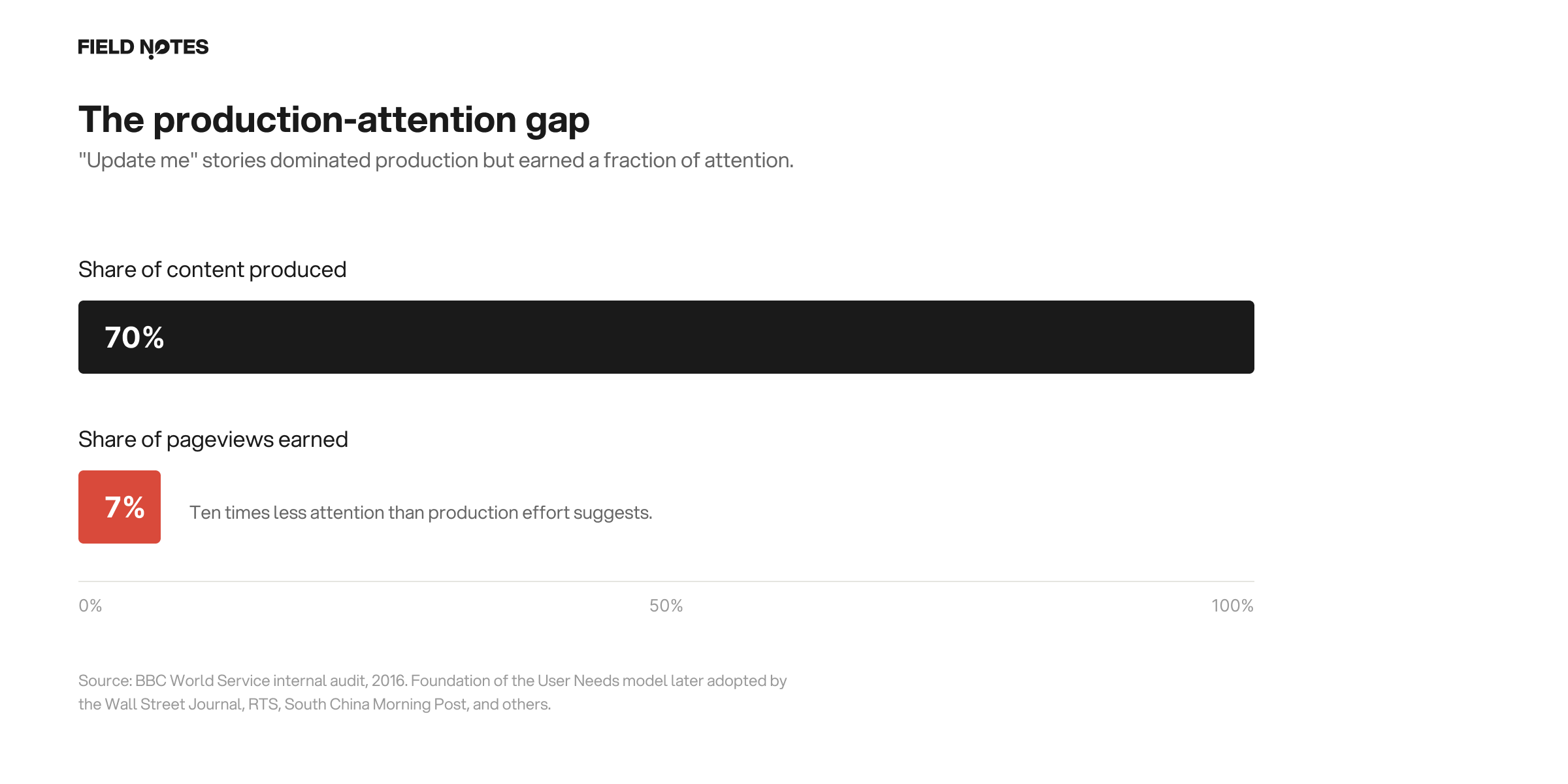
Both frameworks correctly identify that demographics fail because they describe people rather than situations. Both have produced real results in the institutions that have adopted them.
But neither framework was designed for the strategic problem that institutional communications teams now face. Jobs-to-be-done was developed for product strategy in consumer markets; it works best when applied to a single product serving a defined functional need. The User Needs model was developed for newsrooms; it organizes content production but does not extend cleanly to the broader strategic communications portfolio that includes research, events, advocacy, and stakeholder engagement.
What institutions need is a framework that is designed for the actual problem: how to organize strategic communications around what audiences are doing, when they are doing it, and what they are trying to accomplish, across the full portfolio of touchpoints an institution maintains.
A framework for what comes next
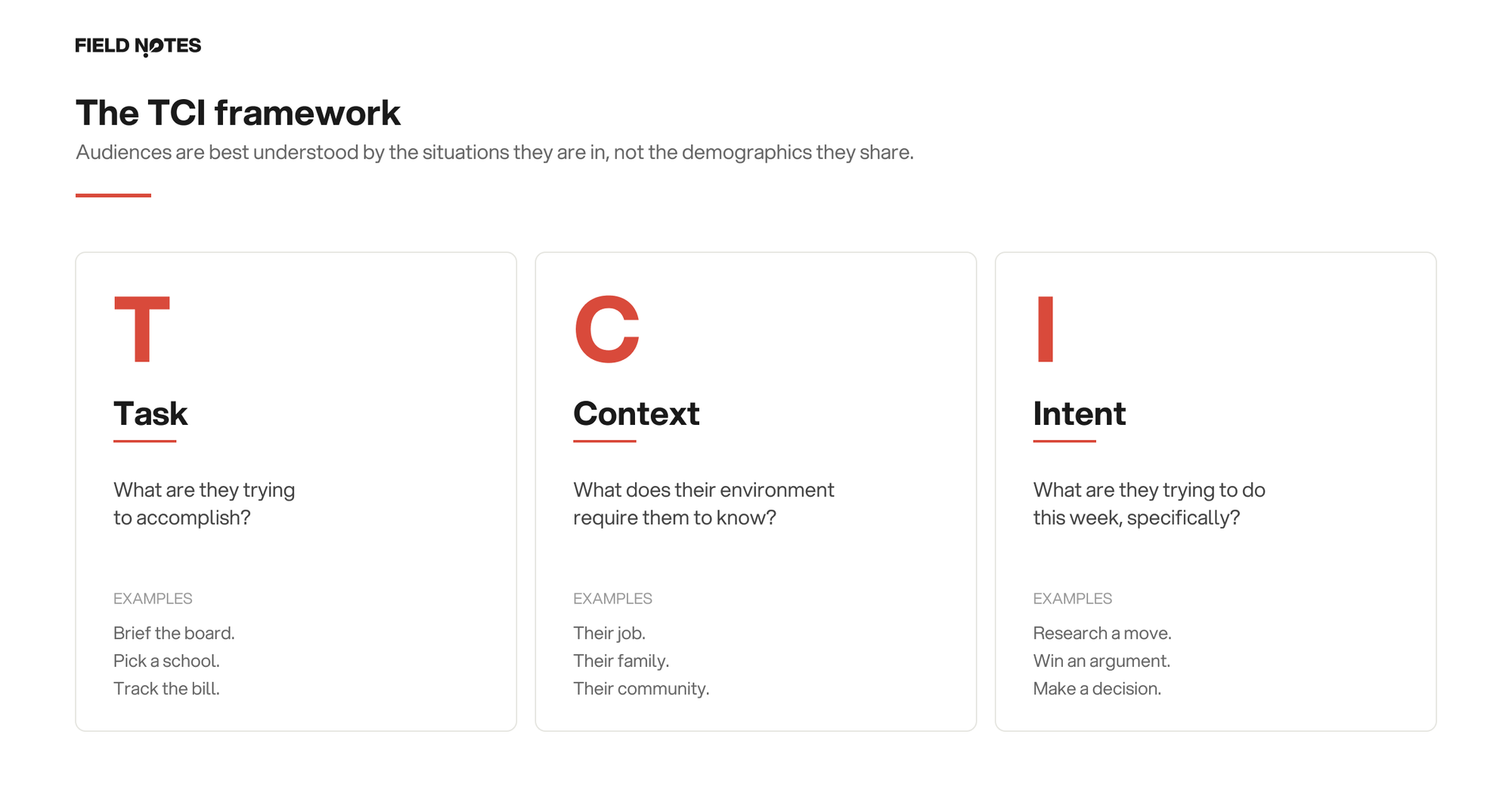
We have been developing one in our work with newsrooms, foundations, and universities, and the short version is this: audiences are not best understood by who they are or even by the discrete jobs they hire content to do. They are best understood by the situations they are in.
A situation has three components.
The first is task. What is this person actually trying to accomplish, in their work or their life, that your communication touches? A school board member trying to follow district budget debates is performing a different task than a parent trying to figure out which schools to apply to. They might be the same age, in the same town, with the same income. They are not the same audience.
The second is context. What does this person's surrounding environment require them to know? Context is the part demographic segmentation comes closest to capturing, and the part it most consistently gets wrong. A nonprofit executive director running a $20M organization has to track state budget cycles whether she enjoys it or not. A retiree in the same zip code does not. The first will read your statehouse coverage closely. The second will not, even if she tells every survey she is "engaged with local issues." Context is professional, civic, and personal; it predicts attention better than demographics do because it describes what is at stake for someone, not just where they sit on a chart.
The third is intent. What is this person trying to do this week? Not in the abstract. Actually this week. Someone considering a move to a new city is in a research mode that lasts maybe sixty days, after which they will never click on "neighborhood guide" content again. Someone whose teenager just got into a school redistricting fight is in a research mode that lasts about three weeks. Demographics will tell you they are parents. Intent will tell you they need three specific articles, in a specific order, in a specific window, and that after that window, they are a different audience again.
We call this task, context, intent, or TCI for short, and the practical value of the framework is that it produces different answers than demographic or even jobs-to-be-done analysis would produce. It tells you which audiences are durable and which are episodic. It tells you which products are doing the work you think they are doing and which are filling time. It tells you when to invest in someone and when to let them pass through. It tells you what to build next.
Most importantly, it tells you something demographics never can: what makes your work irreplaceable to a specific person at a specific moment.
What this changes
Institutions that adopt situation-based audience thinking tend to make three kinds of changes within the first year.
They stop launching products in search of audiences and start identifying audiences in search of products. The question shifts from "should we launch a podcast" to "what task is currently being done badly for the people we serve, and is a podcast the right form for that task." That sounds obvious, but in practice it kills more bad product launches than any board oversight ever has.
They restructure their audience research. Demographic surveys still have a role for funder reporting and broad market sizing, but they are no longer treated as the foundation of strategy. Strategy is built on situation research: interviews, ethnographic observation of how people actually use information in their work, and longitudinal tracking of how task and intent shift over time. This is a different research practice, and it requires a different relationship between communications, editorial, and research functions inside the institution.
They develop the discipline to specialize. Demographic thinking encourages institutions to chase breadth, because demographics describe everyone. Situation thinking encourages institutions to specialize, because situations are specific. The institutions that grow audience over the next five years will be the ones willing to be radically clear about whose situations they are designed to serve, and equally clear about whose situations they are not.
That last move is the one institutions resist most. It feels like leaving audience on the table. It is actually the opposite. Demographic thinking has been leaving audience on the table for two decades, by chasing categories that no longer cohere. Situation thinking finds the audience that has been there all along, doing the work, waiting for someone to recognize what they were actually trying to do.
The demographic spreadsheet has done all the work it is going to do. The institutions that understand that already are five years ahead. The ones that do not will spend those five years wondering why the numbers keep moving in the wrong direction.