

A few months ago, a newsroom told me it wanted to reach younger audiences. I asked the obvious follow-up question, the one nobody at the table had asked yet: how many young people actually live in your coverage area? They didn't know. So we looked. The number was small, and most of the people in it were already leaving for college or for work somewhere else. The newsroom had built a year of strategy, hires, and platform experiments around an audience that, in any meaningful sense, was not there.
This is not a story about one newsroom. It is a pattern I see constantly, and it has a particular shape. A goal gets set because it sounds like the right goal to have. "Reach younger audiences." "Grow our diverse readership." "Build a Gen Z strategy." Nobody in the room is acting in bad faith. Everyone wants the newsroom to have a future. But the goal was never built downstream of who the community actually is or who the newsroom is actually failing. It was built downstream of what a goal is supposed to sound like in 2026.
I want to give that pattern a name, because naming it makes it easier to catch. There are performative audience goals, and there are accountable ones. Most newsrooms have more of the first kind than they think.
What separates the two
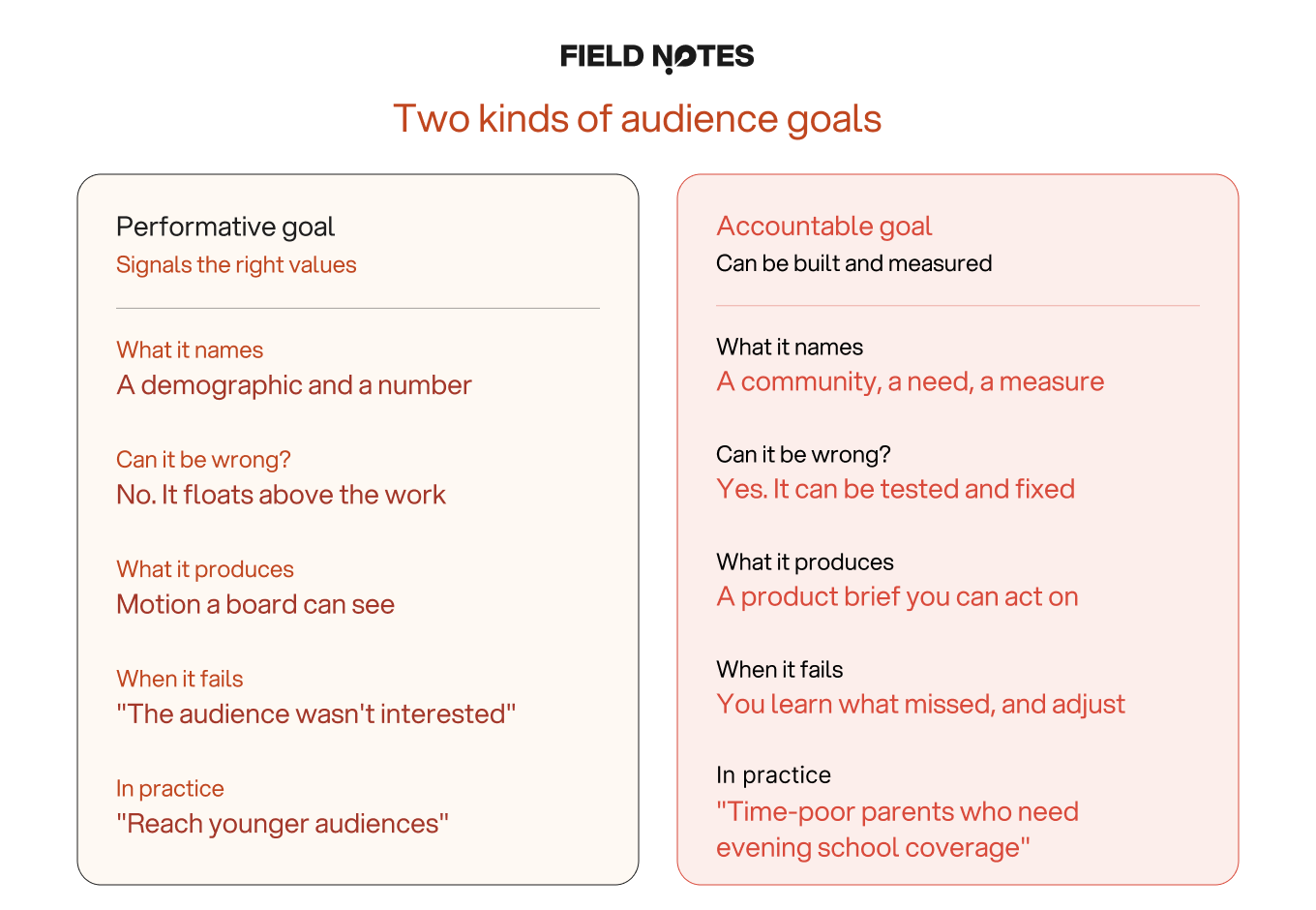
A performative audience goal names a demographic and a number. Reach more young people. Grow the diverse audience to some percentage. The goal is satisfying to say out loud because it signals the right values and the right awareness of where the industry is going. It is also, structurally, almost impossible to be accountable to, because it never specifies a real community, a need the newsroom can actually meet, or a way to know whether anything worked.
An accountable audience goal names three different things. It names a specific community that exists in your coverage area. It names a need that community has, which your newsroom is positioned to meet better than the alternatives. And it names a way you will know if you succeeded that is not simply the size of the demographic you were chasing.
The difference is not ambition versus modesty. An accountable goal can be enormous. The difference is that one of them can be wrong, and the other one cannot. A performative goal floats above the actual work. You can pursue it for two years and never be forced to confront whether it was the right thing to pursue, because it was never specific enough to fail honestly. An accountable goal exposes itself. It can be tested, it can be missed, and it can be corrected. That is the entire point of having it.
The performance is the comfortable part
It is worth being honest about why performative goals are so sticky, because the reason is not stupidity. It is that the performance is genuinely easier and more comfortable than the alternative.
A goal like "reach younger audiences" lets a newsroom demonstrate effort without committing to a verdict. You can launch the TikTok account, hire the social producer, run the vertical video pilot, and report all of it upward as progress. The board sees motion. The funders see alignment with the trends. And if, a year later, the young audience has not materialized, the failure is diffuse enough that nobody owns it. The newsroom "tried." The conclusion quietly becomes that the audience was simply not interested, which is the most expensive conclusion a newsroom can reach, because it is usually false and it ends the inquiry.
Compare that to the discomfort of an accountable goal. To set one, you have to look hard at your actual community and admit who you have been failing. That admission is rarely flattering. The honestly underserved audience in a given town is often not the glamorous one. It is not the demographic that scores well in a strategy deck or photographs well in a funder report. It might be aging readers who lost the print edition and were never given a real digital path back. It might be rural, lower-income households that no platform strategy is designed around. It might be a working population that is technically "diverse" but whose actual unmet need is something mundane, like reliable local government coverage at a time of day they can read it.
Serving that audience is unglamorous, and it is hard, and it does not generate a satisfying line in a board update. So newsrooms reach instead for the goal that performs well in the room, and the underserved community that was sitting right there stays underserved. The performance is not a substitute for the work by accident. For a lot of organizations, it is a substitute for the work because the work is less comfortable.
"Reach younger audiences" is the clearest example
Take the most common performative goal in the industry right now and run it through this.
The pull toward youth is everywhere, and the industry data is real. Reuters Institute research finds that around 15% of under-25s use AI chatbots weekly for news, compared with far lower rates among older groups, and nearly four in five publishers say they are prioritizing video in 2026, much of it explicitly aimed at younger audiences. None of that is fiction. Younger news consumers do behave differently, and there are newsrooms with the geography and the mandate to make a serious play for them.
But notice what "reach younger audiences" does and does not specify. It names a demographic. It does not name a community in your coverage area, a need, or a measure of success. And the moment you try to make it specific, it tends to fall apart in one of two ways.
The first way is the one I opened with. There are simply not many young people where you publish. In that case the goal is not a strategy, it is an aspiration borrowed from newsrooms whose geography is different from yours. The most useful research of the past year does not actually tell newsrooms to chase youth harder. The Reuters Institute's decade-spanning study of 18-to-24-year-olds reframed the entire question: instead of asking how to lure young audiences onto newsroom platforms, it asked what young people want news to be, and the answer was that they want it to be more relevant and, frankly, more enjoyable. INMA's young audiences work lands in a similar place, arguing that authenticity beats demographics every time, that audiences do not want young people explaining the news to young people, they want people who genuinely know the subject speaking in a way that respects the platform. Both of those are arguments about relevance and quality. Neither is an argument for setting a numeric youth target in a town with very few young people in it.
The second way is more interesting, and it is the reframe I would push hardest. Sometimes the instinct underneath "we need younger audiences" is correct, but the label is wrong. What the newsroom actually senses is that its audience is aging into disengagement and it has no pipeline of newer, lighter-touch readers replacing them. That is a real and serious problem. But the solution is not necessarily a 22-year-old on TikTok. In a lot of communities, the genuinely underserved "next" audience is 40 years old. They are mid-career, raising kids, time-poor, plugged into local life in a way a transient 20-something is not, and no one has built a single product decision around their actual day. They are the growth audience. They were just never as fun to name in a meeting as "Gen Z."
That is the test in miniature. "Younger audiences" is a demographic. "Time-poor 40-year-old parents in our county who need local government and school coverage they can act on, delivered when they can actually read it" is a community, a need, and the beginning of a measure. One of those is performative. The other one you can be held to.
Where TCI comes in
This is where our TCI framework does the real work, because TCI is the tool that converts a performative goal into an accountable one.
TCI asks three questions about an audience. What is the task they are trying to accomplish? What is the context they are in when they show up? What is the intent, the underlying need, that brought them to you rather than somewhere else? A demographic answers none of those questions. "Young people" is not a task, a context, or an intent. It is a category that happens to correlate, loosely and unreliably, with all three. That correlation is exactly why demographic goals feel actionable while delivering so little: they look like a target, but they do not tell you a single concrete thing about what to build.
 Adriana Lacy
Run the same audience through TCI and the performative goal cannot survive, because TCI forces specificity at exactly the point where performative goals stay vague. You cannot describe a task without describing a real person in a real situation. The 40-year-old parent has a task (find out whether the school budget vote affects them), a context (ten minutes between obligations, on a phone, probably in the evening), and an intent (make a decision, not browse). The moment you have written that down, you no longer have a demographic goal. You have a product brief. You know what to make, where to put it, and what it would look like for it to work.
This is the through-line from "What Demographics Miss." That piece argued that situation beats demographics as the basis for audience strategy. This is the operational consequence of that argument: if situation is the real unit, then any goal expressed purely in demographic terms is, by definition, not yet accountable. It has not been specified down to the level where it can be built or tested. TCI is how you do that specifying. Performative goals are the ones that never get run through it.
How to tell which kind you have
You do not need a consultant in the room to audit this. You need three questions, and you need to be willing to sit in the silence if the answers do not come.
First: does this goal name a community that actually exists in our coverage area, at a size worth serving? Not a demographic in the abstract. A community you could, in principle, count. If the honest answer is that you have never checked, that is the finding.
Second: does it name a need we can meet better than the alternatives? Reaching an audience is not a need. The audience already has news sources, including ones that are free, fast, and algorithmically tuned to them. The question is what unmet need you are uniquely positioned to serve. If you cannot name it, you do not have a strategy, you have a hope.
Third: will we know if we succeeded, in terms other than the size of the demographic we were chasing? A real goal has a signal of success that reflects whether you served the community, not whether the community is large. Engagement depth, return behavior, the audience telling you that you covered something that mattered to them. The Center for Media Engagement's work on engaged journalism is instructive here: newsrooms that built reporting around audience-submitted questions saw measurably more positive community attitudes, and new revenue alongside it. That is what an accountable outcome looks like. It is a relationship that can be observed, not a headcount that can be wished for.
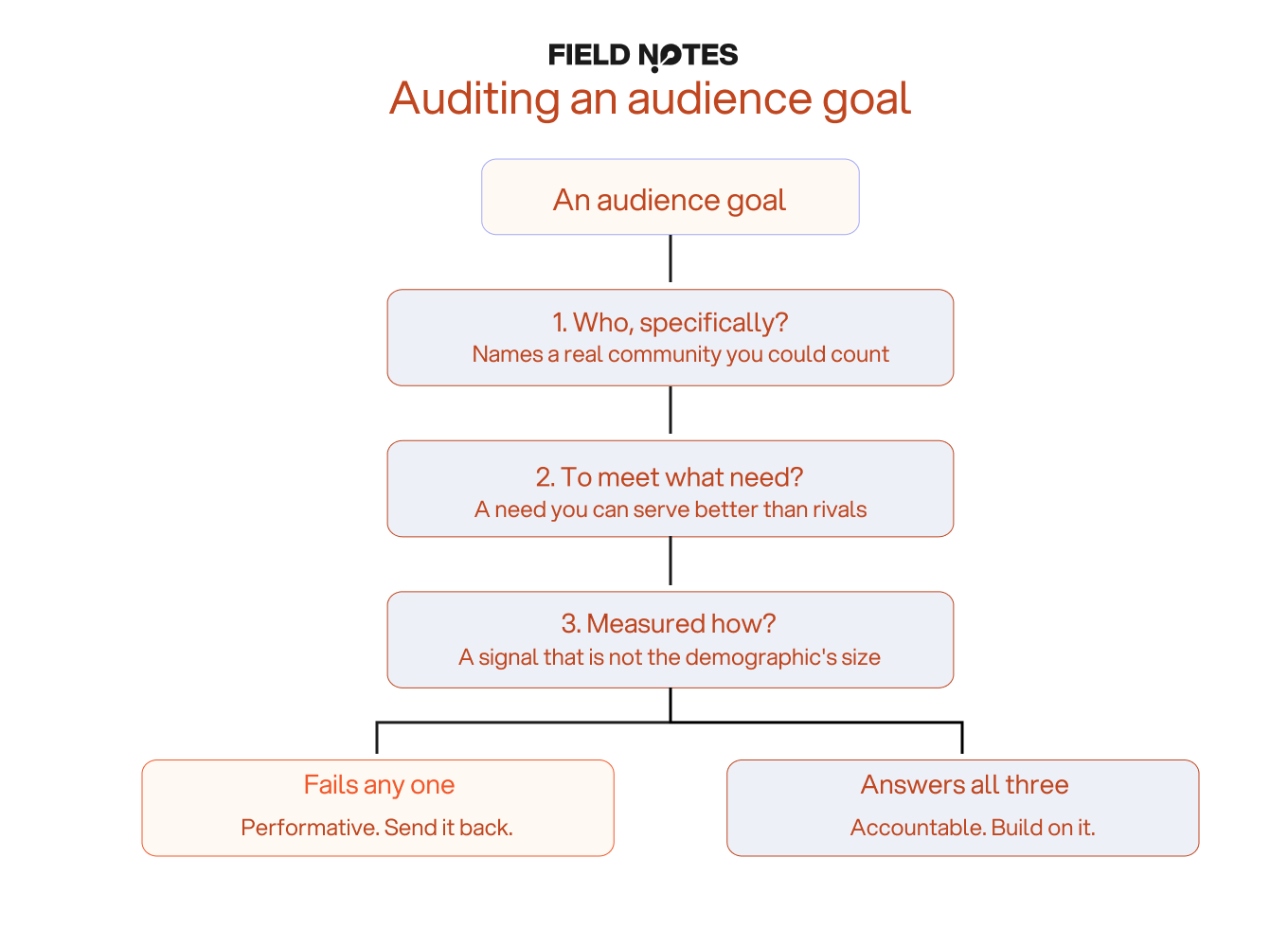
If a goal cannot answer all three, it is not necessarily a bad instinct. But it is not finished. It is a performance of a goal, and it needs to be sent back and made real before anyone builds a year of work on top of it.
The actual stakes
None of this is an argument against ambition, and it is emphatically not an argument against serving audiences a newsroom has historically left out. It is closer to the opposite. The performative version of an audience goal is the one that fails those audiences, because it treats them as a number to be reached rather than a community to be served, and a number cannot tell you it is disappointed in you. When the number does not move, the newsroom concludes the audience was not interested and moves on. The community is left exactly where it started, except now there is a slide deck explaining that the newsroom tried.
An accountable goal is harder to set. It requires looking honestly at your own coverage area, naming the people you have been failing even when they are not the people who look impressive in a funder report, and committing to a definition of success you can actually be measured against. That is uncomfortable. It is also the only version of the work that respects the audience enough to be useful to them.
The next time someone in your newsroom says you need to reach a particular audience, do not argue with the ambition. Just ask the three questions. Who, specifically. To meet what need. Measured how. If the goal can answer, build on it. If it cannot, you have not lost anything by finding out now. You have just been handed the chance to set a real one.