

When I walk into an organization to talk about AI, the biggest gap I see is that everyone knows they should be using it, but they don't actually know what exactly they should do. There's a lot of confusion. Many teams are still treating AI as a dirty little secret, with no clear policies, even as plenty of people inside are already embracing it.
I like that people are open to AI. But I keep seeing the same gaps. People aren't troubleshooting. They don't understand the limitations of these tools, or that what's happening on the other side of the screen isn't really thinking. And what worries me most lately is that some leaders may be outsourcing their most important decisions to something that isn't human.
New data from Anthropic, the company behind Claude, gives us a rare look at whether that worry holds up.
What the data shows
The Anthropic Economic Index tracks what people bring to Claude by matching anonymized conversations to the tasks that make up different jobs. It doesn't tell us who is using AI or how many people in a given profession are using it. What it does show is which kinds of work people bring to AI, and whether they treat it as a collaborator, going back and forth and refining the work together, or hand the task off and let the AI complete it.
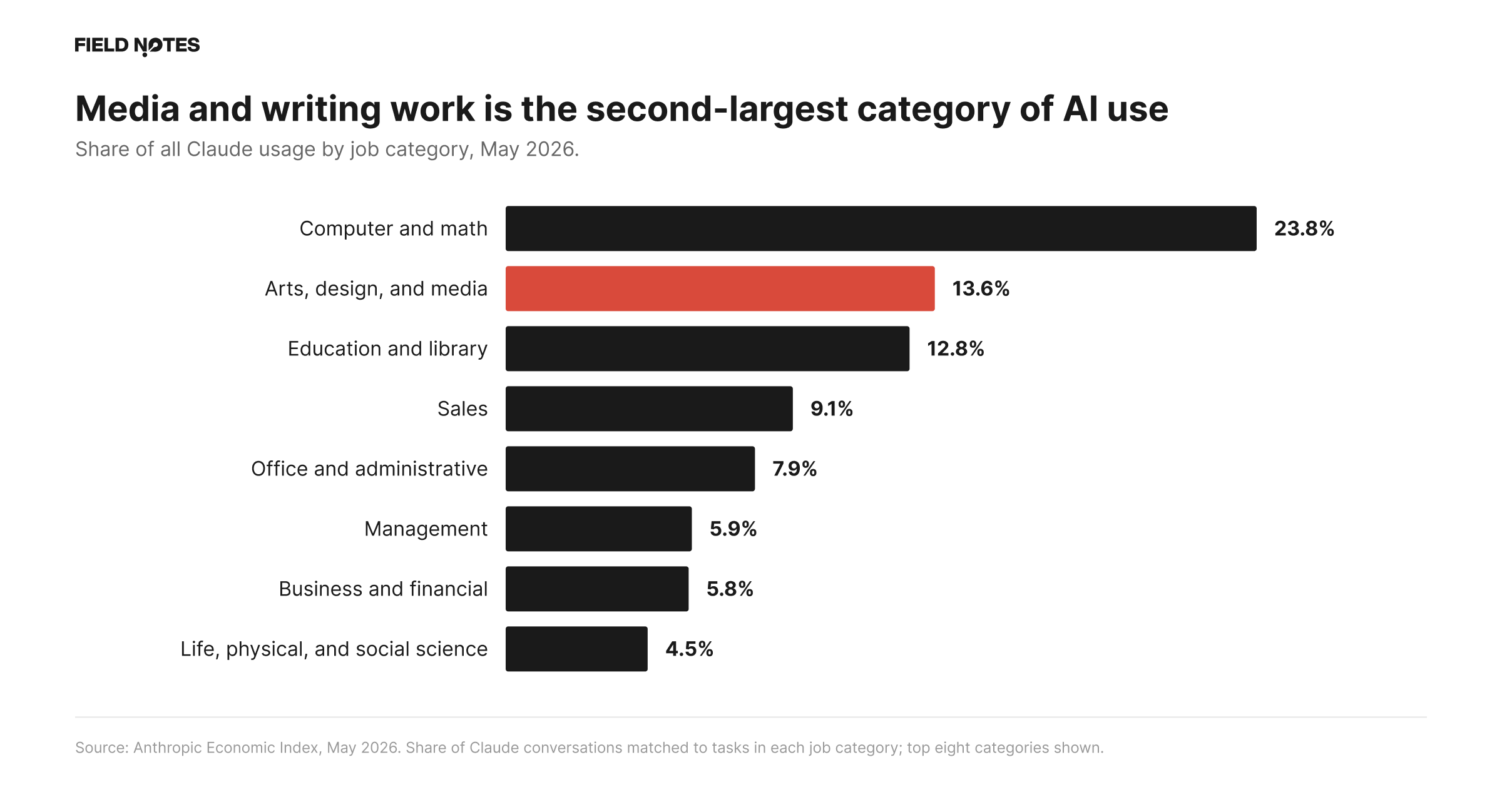
The broad picture first. Creative, writing, and media tasks make up the second-largest share of all usage worldwide, about 13.5 percent, behind only computing and math and ahead of education. Editing tasks rank fourth out of more than 700 occupations tracked, and writing tasks rank fifth.
When it comes to making things, people overwhelmingly collaborate. Revising work to meet an editor's approval is handed off in just 12 percent of conversations. Evaluating manuscripts and conferring with authors about changes is handed off in 10 percent. Writing press releases sits at about a third. People draft, revise, push back, and draft again.
The deciding work looks different. Choosing which wire stories matter enough to run leans 61 percent toward handoff, and deciding which topics to cover leans 56 percent. On the executive side, reviewing reports submitted by staff and recommending whether to approve them leans 69 percent, and conferring with board members and staff to resolve problems leans 62 percent. Public opinion research, the work of figuring out what people actually think, also leans 62 percent.
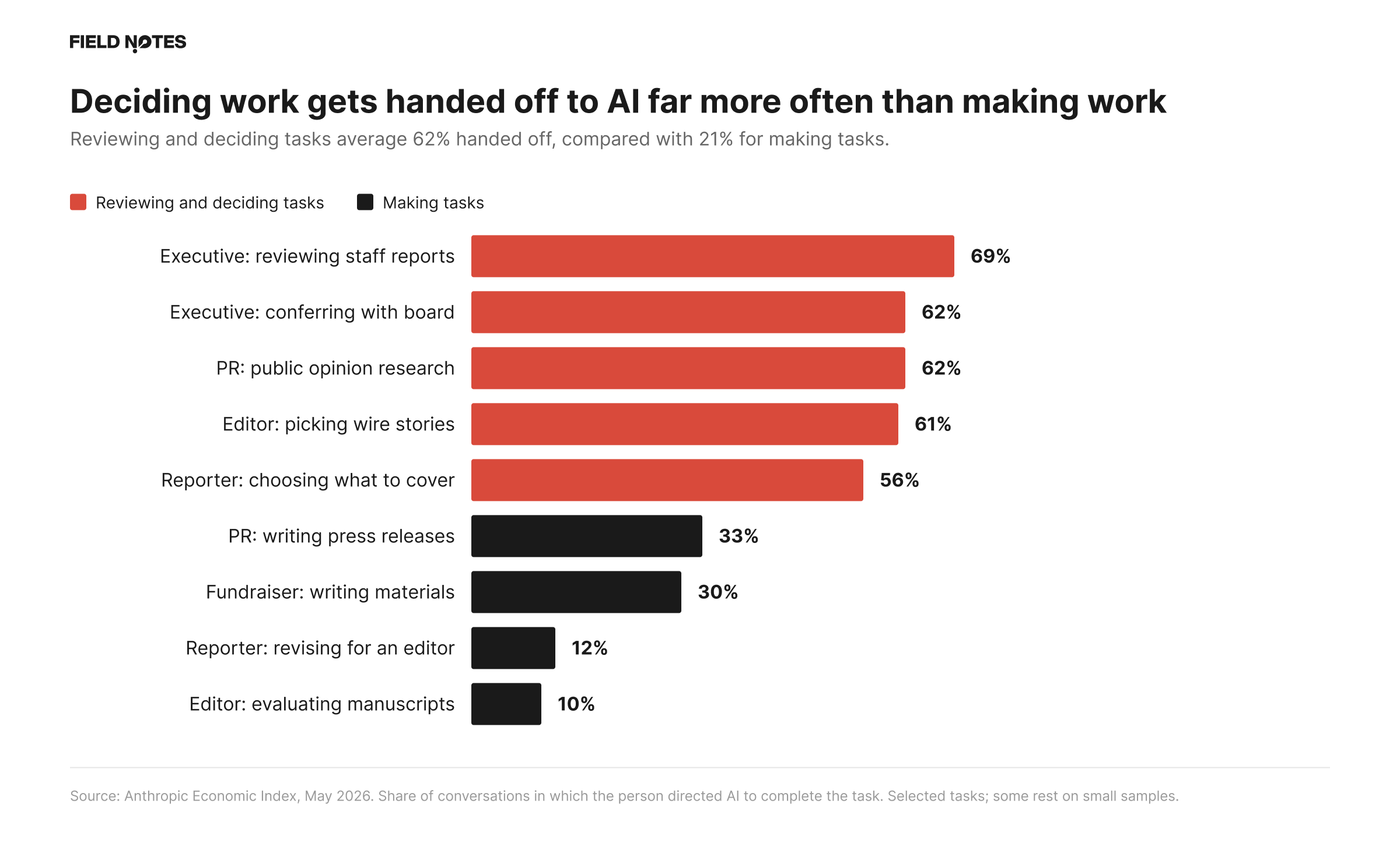
Some caution is warranted here. Task-level figures can rest on small samples, and this is a single snapshot from May 2026 rather than a trend. Still, the pattern shows up across very different kinds of work, from newsrooms to communications teams to the C-suite. People collaborate with AI on what they make, and they are more willing to hand off what they decide.
Why decisions are getting handed off
That pattern doesn't surprise me, but it does concern me.
I think it shows that a lot of executives and leaders are missing thought partners. It can be lonely at the top, and AI is always available and never judges the question. I know more and more people are using it for decisions, and I understand why. But we know AI carries bias, and there are so many things these systems simply don't know about your organization, your people, and your history.
I also suspect deciding feels safer to hand off because there's no paper trail. If I make a piece of work with AI, someone can run it through a detector like Pangram and flag it. If I say, "Here's my thought," no one can prove that thought came from AI.
A colleague recently described a version of this to me. They hand their boss a strategy memo, and the boss runs it through Claude and comes back with, "Here's what Claude thinks," without really weighing in themselves. I suspect that's happening far more often than most leaders would admit.
Some work should be handed off
None of this means handing work to AI is bad. Posting and updating social content was the single most handed-off task in the data, at 79 percent, and that doesn't surprise me either. Social copy has become so commoditized that I actually think it's a good thing. No one should be spending more than ten minutes thinking up social copy, unless you're writing McDonald's tweets with lots of legal considerations or running pharmaceutical ads.
The real question is which work gets handed off, and whether anyone decided that on purpose.
What goes wrong
When an organization bans AI or pretends it isn't being used, it just sets people up to use it in secret. It's like a speakeasy. You're not going to stop people from using it. You're just going to make them more and more clever about doing it other ways, and that becomes a security risk. Ban AI, and people start putting your sensitive information into their own personal ChatGPT accounts.
When organizations adopt it with no real thought, it creates a janky system. One department becomes AI-native and is doing all sorts of things, while the other departments are scared to touch it, and there's no consistency. In most organizations I'm not seeing clear, universal usage or a streamlined way of working. There might be one unit that's very good at it, and then very little from everyone else. AI has to be rolled out systematically.
What good AI policy looks like
So many AI policies amount to a list: we can use AI for this, we can use AI for that, we can't use it for this. Obviously, you need that. But it's table stakes. What does it actually mean to use AI at your organization? What's the platform of choice? How is leadership thinking about it? What should people actually do?
You wouldn't roll out an enterprise Salesforce without training and systems. Why would you do that with AI?
Almost every policy I've seen governs tools and outputs. Very few say anything about decisions, which is exactly where the data suggests AI is quietly gaining ground.
If I could get every leader to ask one question about AI on their team, it would be, "How is this making your life easier?" So many leaders are looking to replace, replace, replace. I would rather figure out how to maximize what the people I already have can do.
Using AI as a thought partner, well
I use AI for decisions too, constantly. But I'm asking lots of questions. I'm poking holes, asking what I'm missing, looking for the other side, and challenging the answers I get. There is not a world in which I take a single AI output as the decision.
I've also found that the more context AI has, the better its thinking gets. Connecting it to my email, documents, and project tools means it can help me organize thoughts and threads from everything I'm working on, instead of reacting to one prompt in isolation. That's what a good thought partner looks like: informed, open to argument, and never the one with the final word.
How Field Nine approaches it
When a company brings us in to help with AI, the first conversation is about systems.
- How are we using it?
- What are we using it for?
- What are the actual tools?
- What training do people need?
- What are the expectations?
- How are we going to measure growth?
The goal can't just be that more people are logging into Claude. How are they actually using it? What's helping? Where are the inefficiencies? A lot of organizations implement AI without looking closely at the problems it can actually solve.
We approach this work the way we approach product. We do our research, form hypotheses, test, and validate. That might mean running an AI implementation with a small cohort on your team, figuring out what's working and what isn't, and using it as a case study to train everyone else.
Meeting the moment
Organizations are spending a lot of time debating AI, and I understand why. There's an existential crisis underneath it. What happens if we get too good at this and people lose their jobs? What happens if we make a mistake? Leaders know AI is something they need to reckon with, but many haven't sat down and figured out what to actually do.
Meanwhile, the data suggests the decisions are already moving. So here's the question I'd leave with any leader: which decisions in your organization are being shaped by AI right now, and did anyone decide that on purpose?
I want leaders to meet the moment, and that starts with knowing where AI already sits in your work.
This is the first piece in a Field Notes series on how AI is showing up across different kinds of work. Upcoming pieces will look at communications teams, leadership, international usage, and newsrooms.
If your organization is working through its AI strategy, Field Nine Group runs AI workflow audits and facilitated strategy sessions for teams.
Methodology note
Data in this piece comes from the Anthropic Economic Index (anthropic.com/economic-index), published under a CC BY 4.0 license, and covers Claude usage in May 2026. Figures reflect anonymized conversations matched to job tasks from O*NET, the U.S. government's catalog of occupational tasks. They describe what kinds of work people bring to AI, not who those people are or how many people in a profession use AI, and they are not evidence about employment or job automation. "Handed off" refers to conversations where the person directs Claude to complete a task, and "collaborative" refers to conversations where the person stays actively involved. Task-level figures can rest on small samples.
Data analysis and editing support for this piece were done with Claude.